

Support to Industry & Business with ESA
Space Actors: Your Road to Success with ESA
Your journey starts with Space Exchange Switzerland (SXS). Engaging with the space sector, and with the European Space Agency (ESA), involves specific frameworks and processes that may be new to some industries and stakeholders.
SXS provides practical support to help you understand how ESA operates and how to engage with it effectively.
Why collaborate with ESA?
Access to expertise
ESA gives access to a wide network of European technical experts. This can be useful when making technology choices or understanding trade-offs between different solutions.European perspective
Working with ESA helps position your activities within a broader European context and increases visibility across the space sector.Long-term development
ESA programs are often designed to support development over time, not only short-term projects.
What SXS does for you?
The road to success with ESA starts with SXS!
Guidance on ESA processes
SXS helps you understand how to approach ESA, how to initiate a first contact, and how to navigate its structure and programs.Connections with partners
We support you in identifying and connecting with European partners and potential customers relevant to your activities.Access to insights
We provide information on technologies, market positioning, and key challenges in the sector. This includes benchmarking and input from industry.Support for positioning
Based on your current situation and objectives, we help you clarify where you stand and how to position your activities within the space ecosystem.
Supporting the Swiss Delegation at ESA
SXS supports to the Swiss delegation at ESA through participation in key advisory groups and boards, including the THAG (Technology Harmonisation Advisory Group) and the CTB (Component Technology Board). This involvement supports the representation of Swiss interests in European space technology discussions.
The Technology Harmonisation Advisory Groupsupports the coordination of technology priorities across ESA Member States. It contributes to aligning national and European activities, identifying gaps, and defining common roadmaps for future developments.
The Component Technology Board is responsible for the formulation of strategic programs and work plans for technology research and development in the area of European EEE space components. It is also responsible for the harmonization and co-ordination of the collectively funded European space component and technology research and the related development, evaluation, qualification and quality assurance activities.
Expand Your Network and Find the Right Business Partner
As a national platform, SXS is connected to a broad network within the space community. This network includes industrial, institutional, and research actors across Switzerland and Europe.
Our team - particularly Julien Bonnaud and Deborah Müller - can support you in identifying potential partners that match your needs. This may include industrial collaborators, customers, or technology partners, depending on your objectives.
SXS facilitates these connections to help you engage with relevant stakeholders and develop your activities within the space ecosystem.
What is Technology Harmonisation?
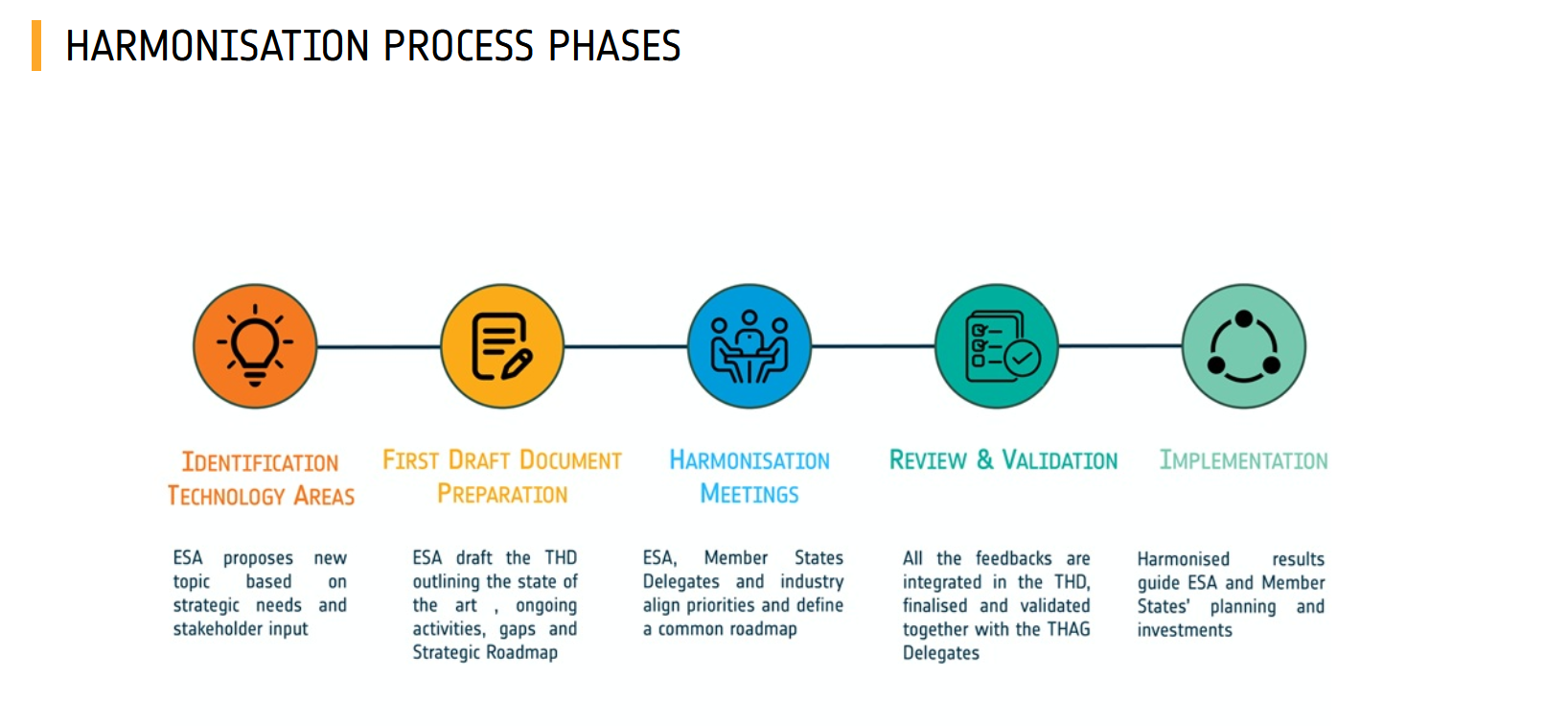
Technology Harmonisation within the European Space Agency is a coordinated process between ESA, its Member States, and industry. Its objective is to align technology development efforts across Europe in order to:
Avoid duplication of work
Identify gaps in critical technologies
Ensure coherence between national and European priorities
Ultimately, harmonisation supports a more efficient use of resources and strengthens Europe’s autonomy in key space technologies.
Purpose and Approach
The Technology Harmonisation aims to understand and respond to Europe’s needs by using and developing existing and/or new technologies. This is achieved through structured discussions between institutional stakeholders and industry representatives.
A central outcome of harmonisation is the definition of technology roadmaps. These roadmaps describe the current state of technologies (“where we are today”), define target capabilities (“where we want to be”), and identify the steps needed over time to reach these objectives. They provide a shared frameworkfor planning research and development activities at both national and European levels.
🎥 Julien Bonnaud explained this approach in a previous interview from our “FOCUS SPACE” series. Let’s now hear him share his mentoring role in supporting Swiss stakeholders and strengthening their position within the European space landscape. Click here.
The harmonisation topics for 2026 are structured around key technology domains within the European space sector. Discover them below:
-
Actuators Building Blocks for Mechanisms
Pyrotechnic Devices (within release mechanisms)
Printed Circuit Boards and Electronic Assembly Technologies
Additive Manufacturing
Micro and Nano Technologies – MEMS Pressure Sensors, MOEMS and RF-MEMS
-
Ground Station Technology
On-Board Computers, Data Handling Systems and Microelectronics
Avionics Embedded Systems
On-Board Software
Radiation Environment and Effects

If you are working in an entity incorporated in Switzerland and you are interested by one of the topics covered by harmonisation, let’s get in touch: